
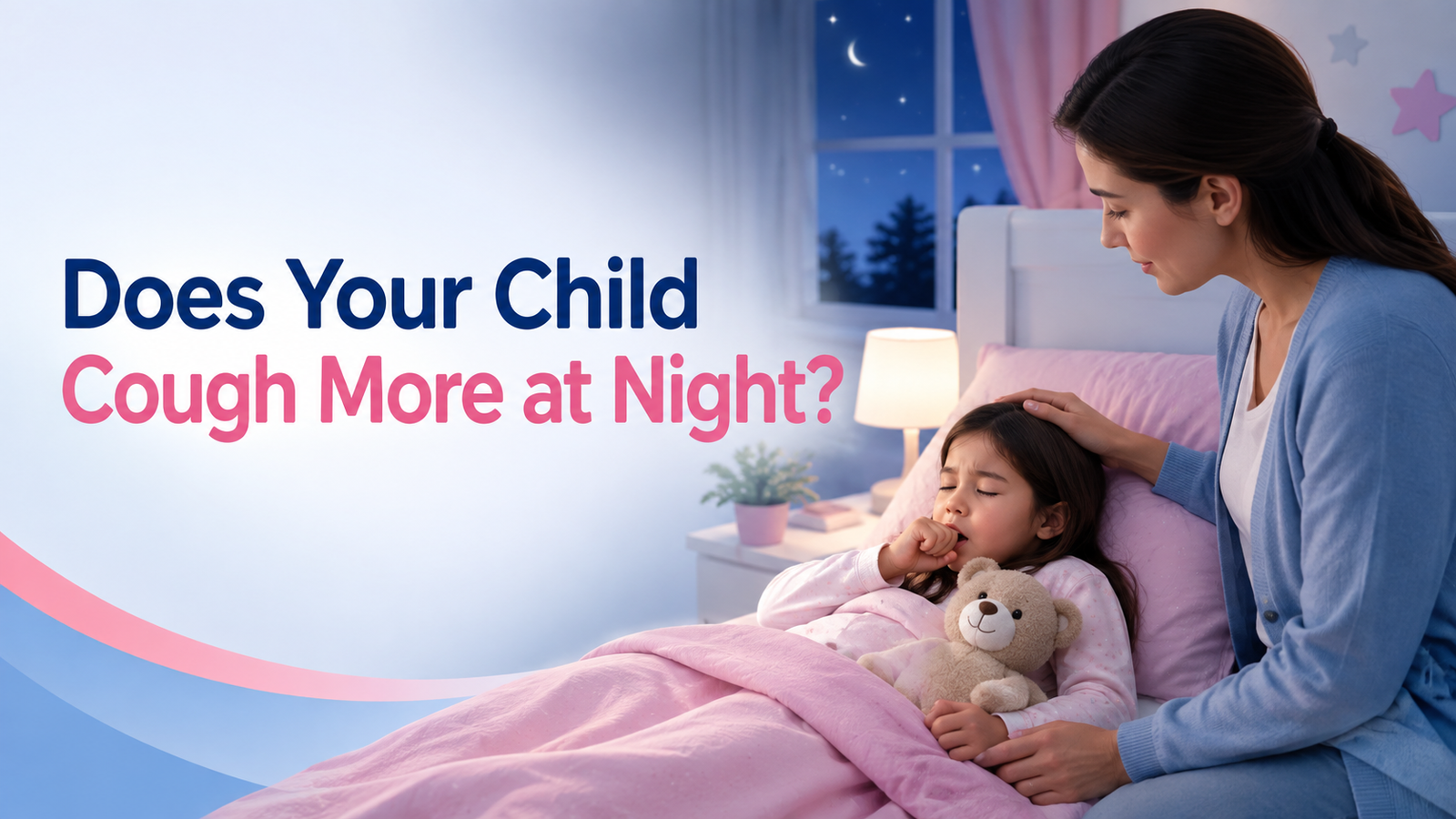
Why Does My Child Cough More at Night?
It can be worrying for a parent when a child seems perfectly active during the day but starts coughing repeatedly as soon as they go to bed. A few coughs with a common cold may not necessarily indicate something serious, but a cough that keeps returning at night, disturbs sleep, or comes with wheezing or breathing difficulty deserves attention.
Nighttime coughing can happen for several reasons. In children with a cold, mucus may trickle down the back of the throat and trigger coughing, especially while lying down. The NHS notes that this is a common reason children cough during respiratory infections.
However, when the cough continues for a longer period or frequently becomes worse at night, it may be important to identify the underlying cause rather than simply trying to suppress the cough.
Common Causes of Nighttime Cough in Children
1. Common Cold and Post-Nasal Mucus
Colds are extremely common in children. When the nose is blocked or producing excess mucus, some of that mucus can travel down the back of the throat. Once your child lies down to sleep, this irritation may make the coughing more noticeable.
If your child is otherwise eating, drinking and breathing normally and does not have wheezing, an occasional cough associated with a cold is often not a cause for alarm.
2. Asthma
One reason doctors pay attention to repeated nighttime coughing is asthma.
Asthma can cause coughing, wheezing, chest tightness and difficulty breathing. According to the CDC, coughing associated with asthma may be particularly noticeable at night or early in the morning.
In some children, coughing may even be one of the first noticeable asthma symptoms. The American Academy of Pediatrics also advises doctors to consider whether coughing or wheezing wakes a child during the night when evaluating possible asthma.
A nighttime cough does not automatically mean your child has asthma, but recurrent episodes should be discussed with a pediatrician.
3. Allergies and Nasal Congestion
Dust, pollen, pet dander and other environmental triggers can irritate the nose and airways in sensitive children. A blocked or runny nose may increase post-nasal drainage, which can trigger coughing after the child lies down.
If coughing repeatedly occurs along with sneezing, itchy or watery eyes, or long-lasting nasal congestion, your pediatrician may evaluate whether an allergy or another nasal condition could be contributing.
4. Respiratory Infections
Some viral respiratory infections can cause a cough that lasts even after the fever and other symptoms have improved.
Croup, for example, typically produces a distinctive barking cough and sometimes a harsh sound while breathing in called stridor. More significant breathing difficulty needs prompt medical assessment.
Another infection parents should know about is whooping cough (pertussis). It can cause repeated coughing bouts that may be worse at night and can sometimes be followed by difficulty catching the breath or vomiting.
5. Environmental Irritants
Smoke, strong fragrances, indoor pollution and other airway irritants can worsen coughing in some children.
A child’s bedroom should ideally be kept free from cigarette smoke and obvious irritants, particularly when they are already recovering from a respiratory illness.
When Should Parents Be Concerned?
The pattern of the cough matters just as much as the cough itself.
If your child’s cough keeps returning, regularly wakes them from sleep, happens during exercise, or is accompanied by wheezing, it is worth arranging a pediatric assessment. NHS guidance also recommends medical review for a cough lasting longer than about three weeks.
Seek urgent medical care if your child develops any of the following:
- Difficulty breathing or is visibly working hard to breathe
- Chest pulling in between or underneath the ribs while breathing
- Bluish colour around the lips or tongue
- Pauses in breathing
- Severe drowsiness, unusual weakness or difficulty waking
- Is too breathless to eat, drink or speak normally
These can indicate significant breathing difficulty and should not be managed simply as an ordinary nighttime cough.
What Can Parents Do at Home?
If your child’s symptoms are mild and they are otherwise comfortable, keeping them well hydrated can help while they recover from a respiratory infection.
For children older than 1 year, a small amount of honey in a warm drink may help soothe coughing. Honey should never be given to a baby under 12 months.
Parents should also avoid automatically giving cough and cold medicines to young children. NHS guidance states that children under six should not be given over-the-counter cough and cold remedies unless advised by a doctor or pharmacist.
Most importantly, home remedies should not delay medical evaluation when the cough is persistent, recurrent or associated with breathing problems.
Why Does Identifying the Cause Matter?
A cough is a symptom, not a diagnosis.
Two children may both cough at night but have completely different reasons for doing so. One may simply be recovering from a cold, while another may have recurrent airway symptoms that require further assessment.
A pediatrician may ask questions such as how long the cough has been present, whether it occurs only at night, whether exercise triggers it, whether wheezing is present and whether the child has a personal or family history of allergies or asthma. These details can help guide the appropriate evaluation.
Don’t Ignore a Persistent Nighttime Cough
Hearing your child cough throughout the night can be stressful, but not every nighttime cough means something serious.
What matters is how often it happens, how long it lasts and what other symptoms appear with it.
If your child’s cough repeatedly interrupts sleep, comes back frequently, is accompanied by wheezing or breathing discomfort, or simply does not seem to be improving, getting medical guidance can help identify the cause and determine the appropriate next step.
Need Pediatric Guidance in Gurugram?
For evaluation of persistent cough, recurrent respiratory symptoms and other childhood health concerns, you can consult:
Dr. Parveen Antil
Kids & Care Clinic
📞 80599 01391
🌐 drparveenkidsclinic.com
📍 Shop 101, Ground Floor, Conscient One Mall, Sector 109, Gurugram
Medical Disclaimer: This article is intended for general health awareness and educational purposes only. It does not replace examination, diagnosis or treatment by a qualified healthcare professional.
Medical disclaimer: This information is for general education and does not replace a medical examination, diagnosis or personalised treatment. Seek urgent medical care for severe or rapidly worsening symptoms.